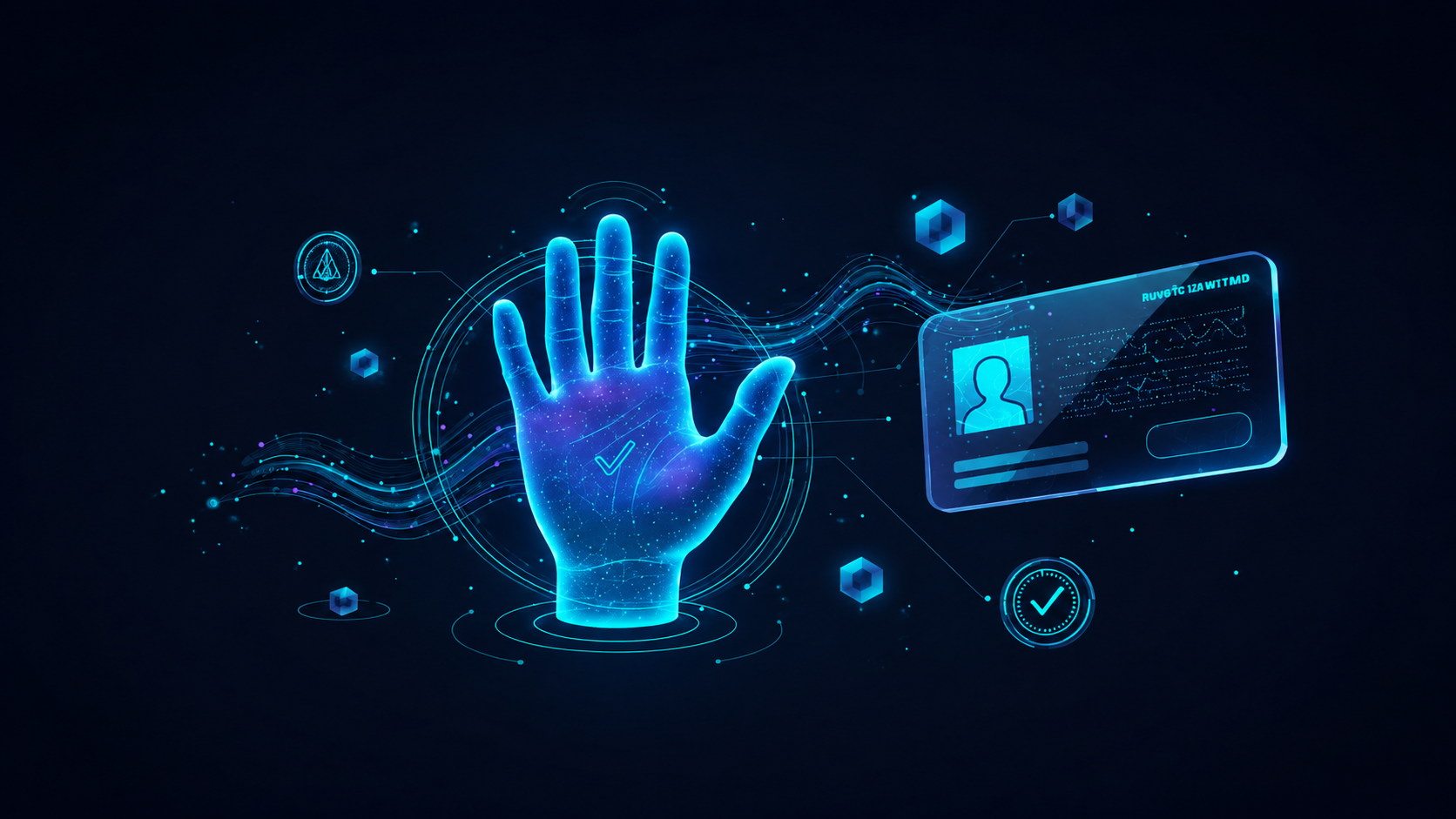
Our client, a blockchain company, is building a global “proof of humanity” network – a way for people to prove online that they’re real, unique individuals without giving up their personal data. We helped them build the backend platform that makes this possible: a system that turns real-world data (bank accounts, loyalty programs, KYC checks) into cryptographically signed Verifiable Credentials, anchored by palm biometrics and secured on the blockchain.
Users connect a real-world account – a hotel or airline loyalty program, a bank account via Mastercard Open Banking, a KYC provider, or a social account. The platform verifies the data, issues a signed credential (for example, “verified net worth above $10K” or “verified frequent traveler”), encrypts it, and anchors it on-chain. Any third party can then confirm the claim is true without ever seeing the personal data behind it.
What we did:
The platform answers a question that's becoming critical across Web3: is the account or wallet on the other side controlled by a real, unique human, or a bot? Biometric proof-of-personhood eliminates Sybil attacks in airdrops, governance votes, ticketing, and loyalty programs, while verified real-world credentials — financial standing, travel status, employment — let other applications personalize services without ever handling raw personal data.
For Humanity, the re-architecture turned a monolith that was hard to change into a platform where new credential types and verification flows can ship in days. And the AI-agentic development approach proved that a lean team can build and operate infrastructure at 8-million-user scale.